
The engine, not the agency
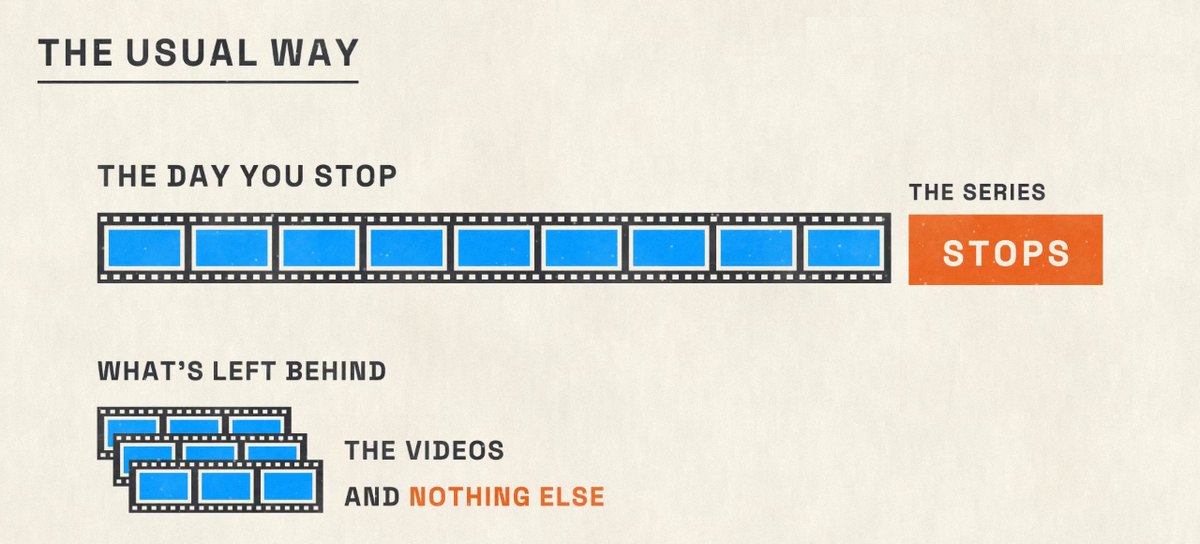
The usual way: an invoice for every episode
An agency makes your episodes. You brief it, it writes, records, edits and delivers, and it bills you for each one. The day you stop paying, the series stops, and what you have left is a folder of videos and nothing else. Most organizations never start a show for that reason, or stop after one season.
AI podcast production is what makes the other way possible. The research, the writing, the voices and, on video, the presenter can now be produced by software, so a show that used to need a crew and a recording day is within reach of a busy professional, or of an organization with an audience and plenty to say and nobody free to record it. What has not changed is who decides. Every script and every finished episode waits for one of your people to approve it, and the engine is built around that.
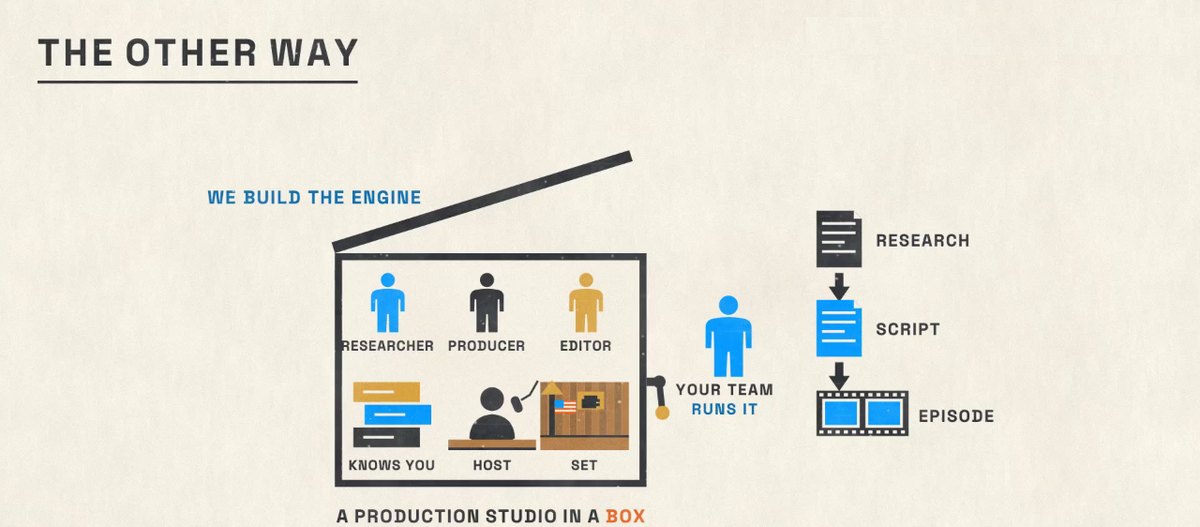
The other way: a production studio in a box
We build the thing that makes the episodes, and your team runs it. Think of a studio in a box: a researcher, a producer, an editor, a host and a set, and it knows you. It reads the sources you choose and your own documents, proposes ideas, writes the script in your hosts' voices, and waits for one of your people to approve it. Then it produces the voices, and on video the presenter, cuts in pictures and titles, waits for a second approval, and publishes. Your people spend their time on what the show should say and whether it is right. For integrations and apps that are not a show, see Custom Integrations, Automations and Business Apps, the general version of this.
Who this is for
- A membership organization or association with members to talk to, and programs, news and history that nobody has time to present.
- A publisher or newsletter that wants a companion show made from each issue, which is what we run for ourselves every week.
- A company with a body of material, such as product knowledge, training or a point of view, and nobody free to stand in front of a camera every week.
- A business owner or expert who wants a show in their own voice and with their own views, without giving up a day to record it.
It is not for interview shows with real guests, or for a show whose whole point is one person's personality on camera. If your host records every week, start with podcast audio production or video production instead.
How an episode gets made
Stories come in
Ideas arrive from a conversation with the producer, from sources the engine watches for you, and from your own team. They land in a backlog you reorder and vote on, and nothing moves forward until a person moves it.
The script is written in your hosts' voices
The engine writes the episode from your own material: the story, the documents behind it and your take on it. Two hosts for audio, one presenter for video, each a character you helped design.
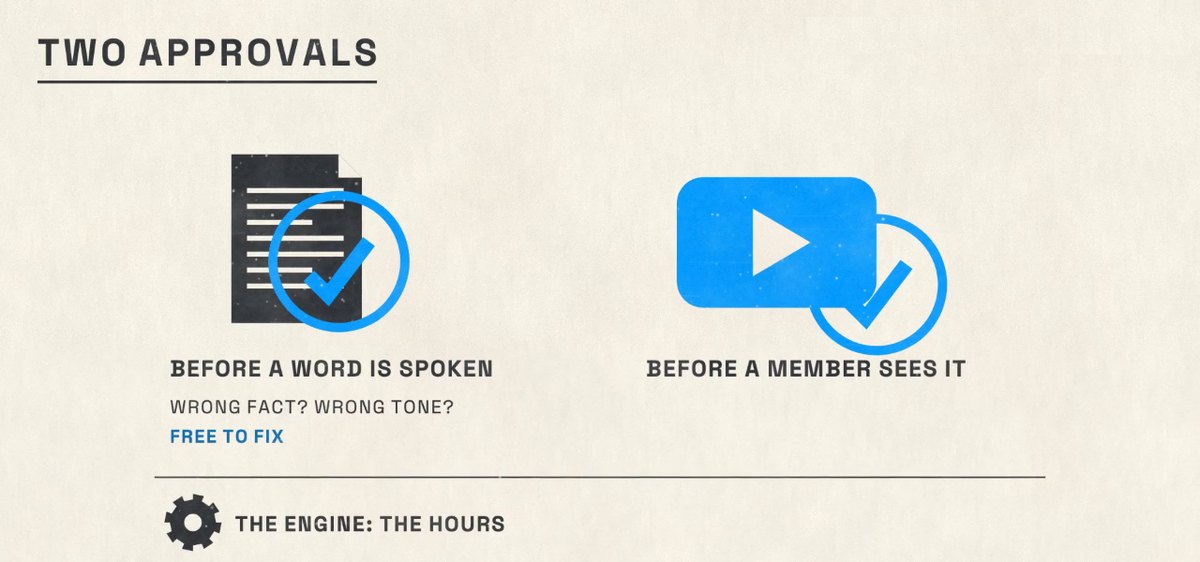
You approve, before a word is spoken
One of your people reads the script, edits it and approves it. The engine refuses to produce audio for a script nobody has approved. That is written into the software, not into a reminder.
The voices, and on video the presenter
The approved script becomes speech, one line at a time, cut, leveled and joined the way an audio editor would do it. On video, the presenter speaks it from the set, and pictures, titles and captions go in where the storyboard says.
You approve again, before anyone sees it
The finished episode comes back for a second look: facts, tone, pronunciation, the picture. Only then does it leave the building.
Published where your audience is
The episode goes to your podcast host, your video platform, your members' area or your site, with show notes written from the script. Every run is logged, so you can always see what happened and when.
Two hosts, one real conversation
Most AI-made shows have one voice reading a script, and listeners can tell within a minute. Our audio shows have two hosts talking to each other: turns, reactions, a bit of teasing, the odd interruption and real disagreement. The hosts know the topic and your business, and you guide the conversation with your own takes before a word of it is written. Press play and judge for yourself.
That is The Intersect, our own weekly show on art and technology, episode 91, "What the Camera Lost When It Stopped Needing You". Every new episode is made this way.
Your host can be you
A host can be a professional, realistic persona with a voice cloned from a real person, made on that person's own account and approved by them. On The Intersect, the curator answers in his own cloned voice. Or the host can be a designed character with a designed voice, a person who does not exist and never claims to. Many shows pair the two: you, and a co-host built for you.
The hosts know your business
Each host is a written persona, and the script writer works from your own material: your documents, programs, history, products and the way you talk about them. So the hosts know the business, not just this week's notes, and speak with the knowledge a long-time staff member would have.
A character built in depth
We develop each host with you: who they are, where they come from, what they know first-hand, how they talk, and what they never say. A character this complete sounds like a person because it behaves like one, episode after episode. The persona lives in the engine's settings, where your team can adjust it without a code change.
The rapport between them
A show's character comes from how the two hosts get on. We set that on nine dials: wit, warmth, opinion, skepticism, playfulness, urgency, authority, intimacy and clarity, plus a list of words the hosts never use. A dry expert and a curious newcomer. Two friends who tease each other. Two specialists who respectfully argue. You can move the dials whenever the show needs a different feel.
Guided by your own takes
Before the script is written, you talk through how the material lands on you: what struck you, a story of your own, where you want the weight and what to leave out. That becomes a brief the writer follows, and your anecdotes are told as yours, never claimed by a host. Once the script exists, you ask for changes in plain words and accept each one with a button.
On video, a presenter in a set built once
Two hosts in conversation is for audio shows today. On video, one presenter carries the episode: a designed host at a desk with a microphone, in a set built once and kept, so the show has a home. The presenter looks convincing at normal player size with a cut to a picture or a title every 15 to 35 seconds, and we build every episode around that rule. We do not promise a face that survives five minutes of unbroken close-up, because none does yet.
What you get
Your hosts, designed with you
The persona, the voice and, on video, the face: developed together, tested in a short stress piece, and chosen by you from a set of candidates. Built once, then kept.
The set and the show's look
For video, one set built once and frozen for the series, with titles and captions in your colors. For audio, the music and the sound of the show.
The show's knowledge base
Your documents, programs, history and past issues, read by the engine so the hosts know what an insider knows. Update it by dropping in a new file.
The backlog and the producer conversation
A board where ideas arrive and get voted on, and a conversation with a producer that has read your material and drafts pitches straight into it.
Research and a script, every episode
The facts behind each story, and the episode written in your hosts' voices from your brief and your material, to the length you set.
Two approvals, every episode
Approval screens for the script and for the finished episode. The engine will not produce or publish anything your people have not approved.
Finished audio or video, show notes and delivery
Mastered audio with the music in place, or a finished video with pictures, titles and captions. Show notes from the script. Delivery to your podcast host, video platform or members' area, with the disclosure wording we agree with you.
A record of every run, and a plan for upkeep
Every unattended piece of the engine logs what it did and puts anything that needs a decision in an inbox for your team. We write down what needs watching and what happens when a vendor changes a tool the engine depends on.
What we have built
The Intersect: a weekly show from a newsletter, with one editor
The problem it solves: a weekly newsletter with a companion podcast normally takes researchers, writers, two voice talents and an audio editor. Here one editor publishes both every week, because the engine does the reading, writing, voicing and mastering and leaves him the judgment.
The Intersect is our own weekly newsletter on art and technology, and its podcast is made by our engine every week. It gathers the issue's stories, writes the two-host script, and waits for the editor to read, edit and approve it. Only then does it produce the voices, master the audio, write the show notes and publish. In the interview format, the editor answers in his own cloned voice.
Narrated explainer and tutorial videos, with nobody recording
The problem it solves: a help video or an explainer waits for a day when someone can record, and goes out of date the month after. From a storyboard, the engine makes a finished narrated video with no camera and no microphone, so a small team keeps its tutorials current and explains every idea worth explaining.
Our tutorials, product tours and explainers start as a storyboard: one picture per idea and two or three spoken sentences, agreed first on a contact sheet the owner comments on. Then the narrator reads the words, the engine films the site or draws the animation in time with the voice, assembles the video, checks every join, and adds subtitles. Some are read by a designed voice, some by the cloned voice of the person presenting. We make videos this way for our own products and for clients every week.
A video podcast engine for a membership organization
The problem it solves: a regular video show for members usually means an agency, a studio day and an invoice for every episode, so most organizations never start one. The engine makes each episode from the organization's own material, with a presenter who is always available, so a weekly show is within reach and keeps going for as long as the members want it.
The host is a designed presenter: a face chosen from a set we made, a matching voice and a character written in depth, at a desk with a microphone in a set built once. Story ideas come in from the organization's own news and from member suggestions into a backlog the team votes on, and a producer that has read the organization's documents turns them into pitches. The engine writes the script in the host's voice, a person approves it, and then it produces the voice and the presenter, cuts in photographs and titles, adds captions and a plain disclosure card, and delivers the episode to the members' video platform after a second approval.
One engine, more shows
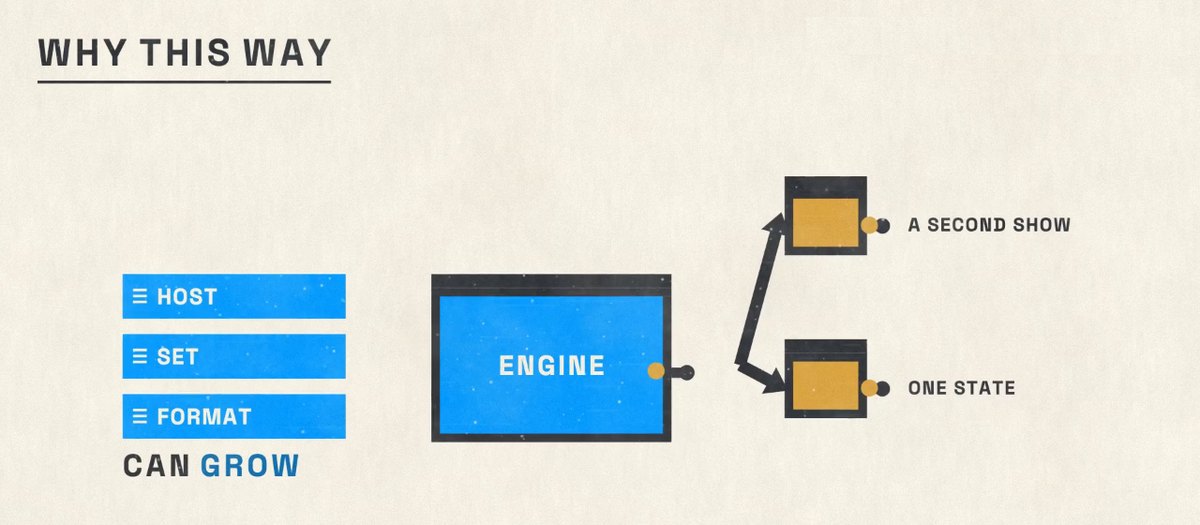
The problem it solves: a second show, a regional edition or a special series normally doubles the cost. An engine that already knows your organization makes the next show from the same hosts, set and format, so your output grows without your team growing with it.
Once the engine knows your material and your hosts, a second show is a new format on the same foundation, not a second production. A national show gains a regional one. A newsletter gains a podcast, and the podcast gains a video edition. The hosts, the set, the knowledge base and the approval screens are already there.
Why production experience matters here
The AI tools are cheap, and anyone can rent them. What makes an episode worth listening to is the craft around them, and that is what we have spent our working lives on: decades of audio, video and podcast production, and before that, years designing software and leading large product teams in finance. We produce videos for clients every week. The engine is those habits written into software.
Writing for the ear
A script that reads well on paper often sounds wrong out loud. We write to the ear: short turns, real reactions, the small hesitations people actually make, counted and kept within a band per minute so the hosts sound like people without sounding sloppy. Delivery cues tell the voice to pause or laugh and are never read aloud. A spoken-name map makes sure a term is said the way your audience says it. And we write in American wording for American voices, because British phrasing gives a cloned voice a British accent.
Voice direction and editing
Every line is produced on its own, then cut and checked for stray sound. Joins are faded, then checked for clicks and gaps. Speech is leveled before any music goes on. The voice engine clips the last syllable of every line, so every line is produced with a throwaway tail that is then cut away. This is what people who have cut audio for decades do without thinking, and we taught the engine to do it every time.
Video craft
A talking head loses an audience in a minute, and a synthetic one loses it faster. So the rule is: never an uninterrupted five-minute talking head. Medium shot. A cut to a photograph, a document or a title every 15 to 35 seconds. The presenter's hands out of the hero frame. A set built once and kept. These are an editor's decisions, and no tool makes them for you.
Workflow design
The engine is designed the way we would design software for a business, because that is what it is. Two approvals: before a word is spoken, and before anyone sees the episode. A backlog your team reorders. Every unattended step logs its run and puts its proposals in an inbox rather than acting on its own. And a written plan for the day a vendor retires a model, so your show carries on while the part underneath it is swapped.
How it works, and what it costs
It starts with a free 30-minute conversation about your audience, your material and whether a show made this way is the right answer for you. If it is, the first piece of work is a paid pilot episode: one episode made the way the engine would make it, with your host, the set, the script and both approvals. You watch it or listen to it and decide. The proposal states the pilot's price before you commit to anything.
After the pilot, we build the engine in stages, each with something working at the end. Building it is a one-time cost, and running it costs far less per episode than paying a crew for each one, which is the point of owning an engine rather than renting a production.
Ownership is agreed project by project. You can license the engine and let us run and maintain it for you, or own the whole thing outright, including the intellectual property. Many clients start with the license and keep the option to buy the entire system later.
What we need from you
- One person who approves scripts and finished episodes, and a little time each week to do it.
- Your material: documents, programs, past issues, product notes, history, and the sources you want the engine to watch.
- Where your audience is: a podcast feed, a video platform, a members' app, your website, or several of these.
- A decision about the host: a designed character, or a real person who agrees to have their voice cloned and makes the clone on their own account.
- Your own takes, as often as you can give them. The show is better when the hosts are thinking with you.
Questions we hear often
Do listeners know the host is not a person?
Yes, every episode. A synthetic host is disclosed to the audience in a form we agree with you: a line in the description, a short card at the end of a video, a sentence in the opening. We write the wording with you. Members-only distribution does not change this; it is a matter of your audience's trust. The Intersect tells its listeners that the curator's voice is a licensed clone and that the interviewing host is AI.
Can the hosts use my voice?
Only if you make the clone yourself, on your own account, and share it with the engine. The voice vendor allows only the owner of a voice to clone it, even with written consent, and we think that is right. If you would rather not, a designed voice needs no consent and sounds just as natural.
What if the presenter does not look right?
That is what the pilot is for. We make a short stress piece first, with difficult names, a smile, a pause and a gesture, and you see how convincing the presenter is at the size your audience will watch. If it falls short, there are fallbacks: a different rendering engine, or a short recording of a real stand-in that turns the character into a learned likeness without changing anything else.
Is this only for podcasters?
No. Most of the organizations this fits have never made a podcast. They have an audience and a lot to say to it, and no time to say it. A members' briefing, a weekly update for customers, a series on the history of an institution, a companion show for a newsletter: these are shows, whether or not anyone calls them podcasts.
Who owns the hosts and the set?
You do, under either arrangement. The persona, the voice, the face, the set and the knowledge base are made for you and belong to you. Under a license, we run and maintain the engine that uses them; if you buy the engine outright, you own that too, including the code.
What happens when a tool the engine depends on changes?
Vendors improve, re-price and retire their services on their own schedule. We watch for those notices across everything we run, and we build so that each tool is a replaceable part. The lasting assets are yours: the clean audio, the host's picture, the set and the scripts. When a vendor retired models one of our client systems depended on, we had the migration planned the same month, tested side by side before anything live changed.
What happens after I book the initial conversation?
We talk for 30 minutes about your audience, your material and whether a show made this way is the right answer, or whether a simpler fix would serve you better. If it fits, we propose a pilot episode in writing, with its price. The pilot is made, you decide, and only then do we propose the build.